
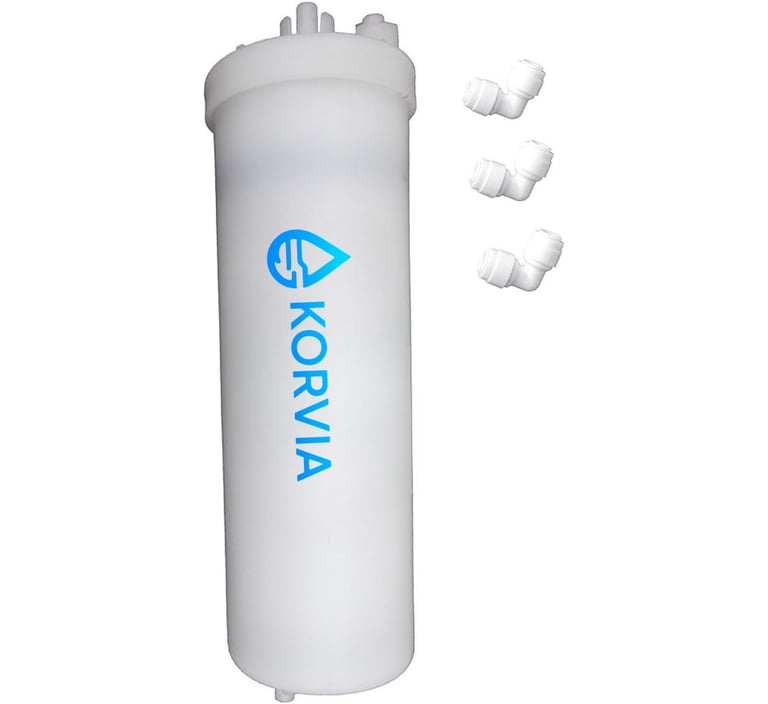

What Are Membrane Filters?
Membrane filters are thin, semi-permeable barriers used in pressure-driven processes to separate particles from liquids or gases. These filters use microscopic pores to allow only particles smaller than the pore size to pass through, ensuring precise and reliable filtration.
How Membrane Filtration Works
The process involves applying pressure to an unfiltered liquid (called the feed stream) to push it through the membrane:
Permeate: Clean fluid that passes through the membrane.
Retentate: Larger particles and contaminants blocked by the membrane.
Unlike depth filters, membrane filters offer absolute filtration—meaning all particles larger than the specified pore size are completely removed.
Types of Membrane Filters
Membrane filters are categorized based on their pore size and what they remove:
Filter TypePore Size (µm)RemovesMicrofiltration (MF)0.1 – 10Bacteria, suspended solids, algae, siltUltrafiltration (UF)0.001 – 0.1Viruses, proteins, colloids, oilsNanofiltration (NF)0.0001 – 0.001Multivalent ions (e.g., Ca²⁺, Mg²⁺), organicsReverse Osmosis (RO)0.00001 – 0.0001Nearly all dissolved salts and solids
Key Advantages
High efficiency: Filters down to the molecular level
Selective separation: Removes specific contaminants based on size
Chemical-free: Reduces or eliminates the need for chemical additives
Consistent quality: Ensures reproducible and high-purity output
Space-saving: Compact systems ideal for limited spaces
Eco-friendly: Reduces waste, recovers valuable materials
Membrane Filter
KORVIA
The core of pure.
CONTACT
support@groclean.in
+91 7985126886 +91 9305980970
© 2025. All rights reserved.